

Hybrid Bias
Condenser capsules are typically either pre-polarized (electret) or externally polarized. Amago’s Hybrid Bias approach combines both: a permanent electret charge on the backplate with an actively controlled bias applied to the diaphragm.
This hybrid configuration offers long-term stability while allowing precise electrical tuning. One direct consequence is exceptional manufacturing consistency: where many condenser microphones specify sensitivity tolerances of ±3 dB, Amago’s typical production variance is under ±1 dB.
µSDC™ Architecture
µSDC™ refers to Amago Audio’s micro-diaphragm microphone architecture, developed to operate beyond the conventional limits of traditional small-diaphragm condenser designs.
While most high-end SDC microphones rely on diaphragms around 12 mm in diameter or larger, Amago employs diaphragms measuring just 4.1 mm and 7.1 mm. Because diaphragm behavior scales with surface area rather than diameter, this represents a reduction in active surface area of approximately 67% compared to conventional SDC geometries.
This shift places the capsule in a fundamentally different transient-response regime: lower moving mass, faster acceleration, and reduced mechanically induced resonances — characteristics that larger diaphragm architectures are physically constrained from achieving.
System-Level Result
Together, Hybrid Bias and the µSDC™ architecture enable a level of mechanical precision, electrical consistency, and sonic accuracy previously unattainable at this scale — delivering micro-diaphragm transient fidelity with self-noise performance traditionally associated with large-diaphragm microphones.
The impulse response is one of Amago Audio’s primary design tools. Unlike a frequency-only plot, an impulse response simultaneously encodes magnitude and phase information in the time domain, revealing how a microphone reacts to fast transients and how it settles afterwards. That makes it uniquely useful for diagnosing problems that a magnitude-only chart can’t show.
Key features to read in an impulse response
- Rise time — how quickly the mic responds to the leading edge of a sound attack (the shorter, the better for transient clarity).
- Fall / settling time — how quickly the output returns to steady state after the transient. Short settling time = low temporal smear.
- Ringing / resonances — oscillations after the main impulse; shows resonant cavities, diaphragm/coating resonances or preamp artifacts. Minimal or no ringing is ideal.
- Pre-ringing (if present) — indicates measurement, deconvolution artifacts or non-minimum-phase behavior.
Why it matters in practice
- A fast, clean impulse → sharper attack, better instrument separation, clearer transient detail (especially on drums, plucked strings, percussive sources).
- Excessive ringing or slow settling → perceived blurriness, smear, and inaccurate localization in immersive formats.
- Impulse issues often point to real physical problems: limited bandwidth, internal reflections, grille/capsule resonances, or preamp phase anomalies.
Here is an impulse response comparison between the O35X and a conventional “high end” microphone. Both plots are normalized to the same peak so you can compare speed and ringing visually.
Although humans can’t hear pure tones above roughly 20 kHz, ultrasonic bandwidth still matters. Real-world sounds aren’t single sine waves — they’re complex waveforms with sharp attacks, decays, and transient details. Some of these changes happen extremely quickly and can only be captured if the microphone’s response is fast enough — similar to how a 240 fps video frame rate makes motion appear smoother and more immediate, even if you can’t consciously see each frame.
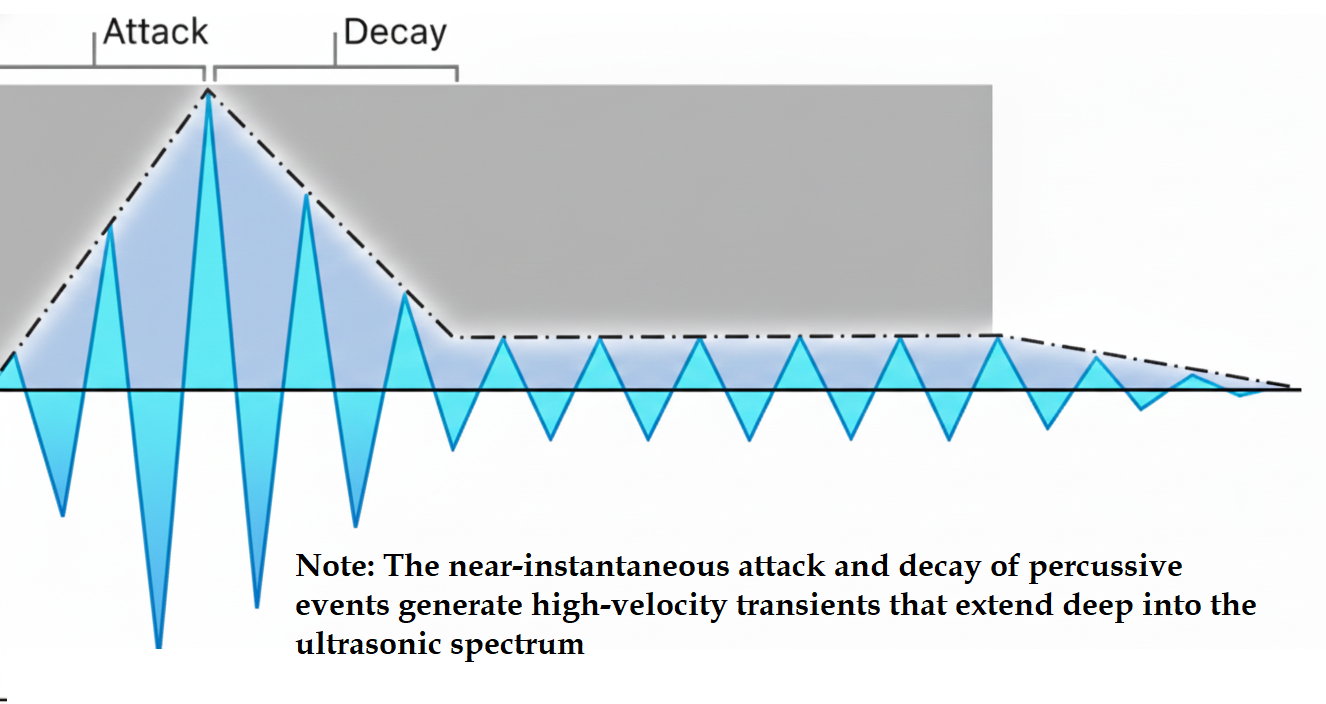
A microphone with extended bandwidth can track these rapid transitions — the leading and trailing edges, micro-timing differences, and tiny transients that shape a sound’s clarity, snap, and spatial realism.
Wider bandwidth also improves impulse response and phase behavior, which directly affects how accurately spatial and percussive information is reproduced. That’s why sources with strong transients (like drums or plucked strings), and spatial formats such as Ambisonics or binaural audio, benefit the most. Wider bandwidth → faster, cleaner impulses → more realistic, immersive sound.
Yes — but the answer is more nuanced than simply saying that humans can “hear” ultrasound.
The conventional upper limit of human hearing through normal air conduction is around 20 kHz, varying considerably with age and individual hearing. Pure ultrasonic tones above this range are therefore not normally audible in the same way as sounds within the conventional audible spectrum.
However, research into human auditory perception shows that our hearing system is considerably more complex than a simple 20 Hz–20 kHz frequency window.
For example, controlled experiments have demonstrated that humans can discriminate temporal differences on the order of only a few microseconds. Research by Milind Kunchur found discrimination thresholds around 5–6 microseconds under specific experimental conditions, demonstrating that auditory temporal resolution can operate on timescales far shorter than might be assumed from the conventional upper frequency limit of hearing.
One useful way to think about this is through high-frame-rate video. You don’t consciously see all 240 individual frames every second, but those extra frames help capture fast motion more accurately and naturally. In the same way, what we consciously perceive isn’t necessarily the limit of how precisely our senses process information.
There is also substantial research into bone-conducted ultrasound. Ultrasonic signals extending far beyond the normal air-conduction hearing range can produce auditory sensations when transmitted through bone, and experiments have shown that even some profoundly deaf subjects can perceive information delivered this way. Neuroimaging studies have also demonstrated activation of auditory regions of the brain during bone-conducted ultrasonic stimulation. The precise mechanisms involved remain an active area of research.
Other research has investigated whether ultrasonic components accompanying otherwise audible sounds can produce physiological or perceptual effects. Results in this area are interesting, but they remain debated, and their relevance to ordinary microphone recording and playback should not be overstated.
To summarize, our interest in ultrasonic bandwidth is primarily an engineering one. A microphone capable of responding accurately well beyond the conventional audible range can be designed for extremely fast transient response and excellent time-domain and phase behaviour within the frequencies we unquestionably do hear.
In other words, we don’t expect you to “hear” a 35 kHz sine wave. But we want the microphone to be fast enough that it can reproduce the acoustic event as faithfully as possible.
For us, it is fundamentally about speed, timing, phase and accurate reproduction of real-world sound.
Further Reading
- Milind N. Kunchur, Temporal Resolution of Hearing Probed by Bandwidth Restriction, Acta Acustica united with Acustica, 2008.
- Milind N. Kunchur, The Human Auditory System and Audio, Applied Acoustics, 2023.
- Tadashi Nishimura et al., Perception Mechanism of Bone-Conducted Ultrasound and Its Clinical Use, Audiology Research, 2021.
- Lenhardt et al., Human Ultrasonic Speech Perception, Science, 1991.
- Nishimura et al., Human Ultrasonic Hearing Is Induced by a Direct Ultrasonic Stimulation of the Cochlea, Hearing Research, 2013.
Most internal microphone preamps max out at 200 KHz, and as such their phase rolls off long before the ultrasonic region (phase rolls off a decade earlier than gain); that roll-off affects phase and timing near the audible range, This is in addition to any AC coupling, noise issues, high output impedance or non linearities that such conventional preamps might introduce. So what you hear at the mic output is a combination of capsule behavior and preamp coloration.
Our preamp circuitry is designed differently: a 1.5 MHz bandwidth, wide dynamic range, Class-A, fully DC-coupled with ultra-low noise and low output impedance (at 70 ohms). All of these features help preserve the diaphragm’s performance, transient rich detail, and phase linearity.
Put simply: instead of the preamp coloring the sound like it does in other microphones, ours simply gets out of the way. The result is faster perceived attacks, cleaner transients, and truer timing coherence— all of which improve clarity and realism significantly.
Those microphones are large-diaphragm condensers (LDCs). Their low self-noise figures are primarily a consequence of diaphragm size: larger diaphragms couple more efficiently to acoustic energy, resulting in higher sensitivity and lower inherent noise.
However, large-diaphragm designs involve well-known trade-offs. Compared to smaller diaphragms, they typically exhibit slower transient response, greater phase shift across the spectrum, increased off-axis coloration, and a higher susceptibility to handling noise and low-frequency smear.
Âmago microphones are built around 4.1 mm and 7.1 mm diaphragms using our µSDC™ architecture, which prioritizes speed, phase coherence, and transient accuracy. Achieving self-noise figures in the 15–19 dBA range at this size represents a genuine technical breakthrough, placing these designs among the lowest-noise ultra-small diaphragm microphones currently available.
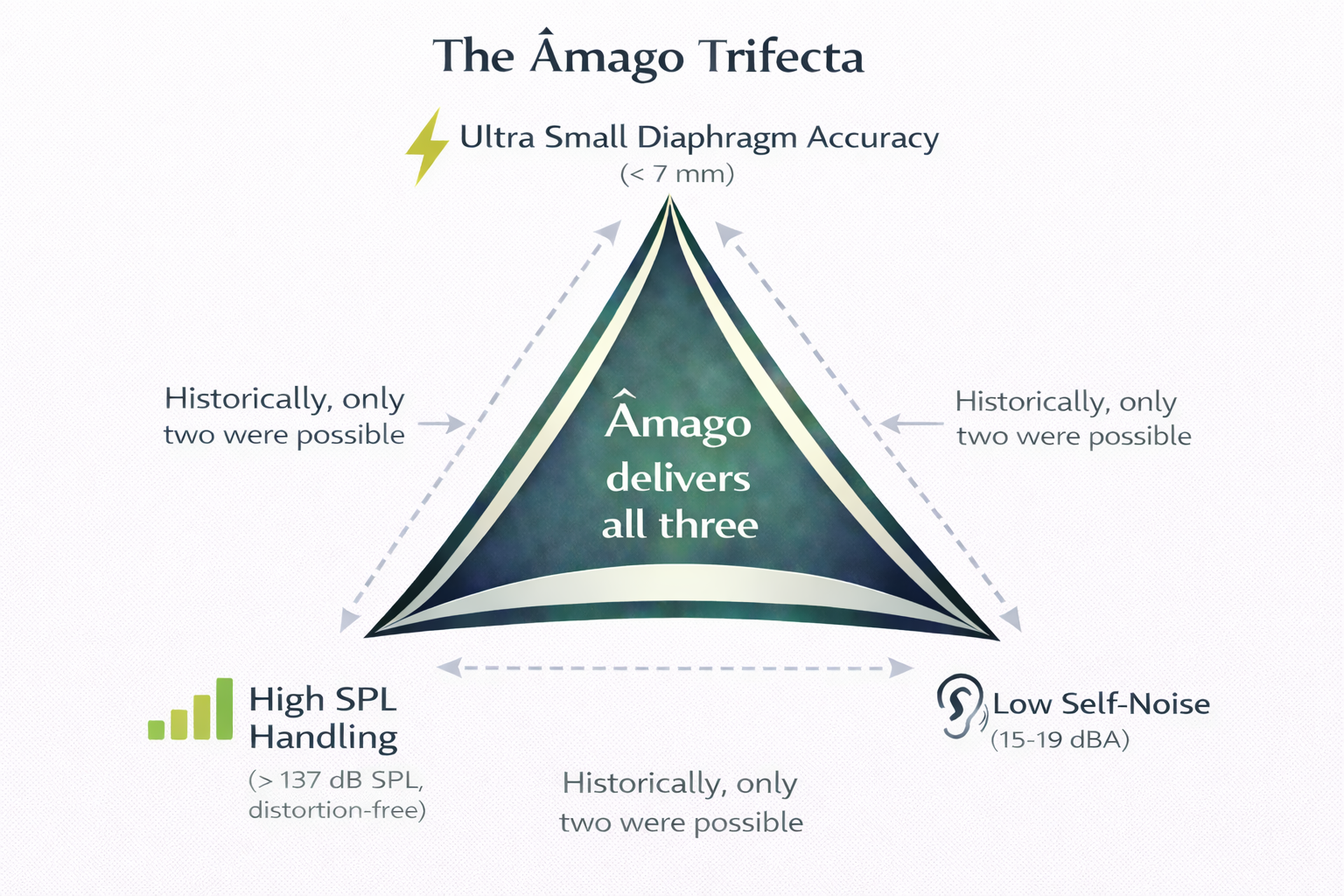
For decades, microphone design meant compromise. In practical designs, only two of these could be achieved at once: low self-noise, high SPL handling, or ultra-small-diaphragm transient accuracy. With Âmago Audio, this long-standing limitation is overcome. We deliver the Perfect Trifecta—where all three coexist in a single microphone design.
Maximum SPL specifications can look straightforward on paper, but the way they are derived — and what they actually describe — varies significantly across the industry. In practice, there are two common approaches manufacturers use to specify SPL limits.
1. Equivalent electrical input limits
Some manufacturers derive maximum SPL from an equivalent electrical input applied directly to the microphone’s internal electronics. This method characterizes electronic headroom, but it bypasses the capsule entirely. As a result, it does not describe how the microphone behaves when exposed to real acoustic sound pressure.
2. Capsule-only measurements
Other manufacturers specify SPL limits at the capsule level alone. This approach is common among companies that design and sell standalone capsules, independent of a specific microphone body or amplifier.
Capsule-only specifications describe the intrinsic mechanical limits of the transducer under controlled laboratory conditions, typically using electronics with far greater headroom than a production microphone preamp. While valuable for design and validation, these measurements do not account for the complete microphone signal path — including biasing, impedance conversion, and downstream electronics — all of which influence real-world performance.
Our approach
We believe that meaningful SPL specifications should reflect what the entire microphone system experiences in actual use.
At Âmago Audio, our maximum SPL figures are derived from true acoustic measurements, referenced to RMS sound pressure and evaluated at clearly defined distortion thresholds. This captures the combined behavior of the capsule, biasing architecture, and electronics as a unified system.
For this reason, we specify two acoustically derived SPL limits:
- Maximum SPL at 3% THD, representing clean, controlled operation
- Absolute, recoverable maximum SPL, representing mechanical and electronic robustness under extreme conditions
This approach provides a more realistic and transparent picture of how a microphone performs in real recording environments.
Let’s start with Mother Nature — she already figured out the size of the perfect diaphragm: your eardrum, about 8 mm across.
When capturing sound — a delicate pressure wave — the goal is to sense it, not disturb it. The lighter and smaller the membrane, the more faithfully it follows the air.
That’s why small-diaphragm condensers (SDCs) — typically under 15 mm — excel at speed, transient accuracy, and smooth, predictable polar patterns. They reproduce the fine timing cues and spatial detail that make recordings feel immersive and immediate. The trade-off is that smaller diaphragms have lower sensitivity, so self-noise tends to be higher.
Large-diaphragm condensers (LDCs), by contrast, bring their own kind of magic. With diaphragms around 20–34 mm, they deliver higher sensitivity, lower self-noise, and a naturally flattering tone that adds warmth — qualities that made them legendary for vocals and many studio applications. The compromise, however, is slower transient response, less-consistent off-axis behavior and phase distortion.
At Âmago Audio, we set out to bridge that gap. Our µSDCs — at just 7.1 mm and 4.1 mm, representing a 67% reduction in diaphragm area compared to conventional SDCs — achieve LDC-class noise performance while preserving the speed and spatial precision of a true small diaphragm.
The result is the immediacy and realism of a miniature diaphragm, combined with the depth and quietness of a large one.
Multi-pattern microphones (those offering switchable patterns like cardioid, omni, and figure-8 in one body) were designed for versatility in the studio. While convenient, this all-in-one approach relies on a core technical compromise that ultimately affects the final audio quality.
Most multi-pattern mics use a dual-capsule (or dual diaphragm) design—two physically separated capsules stacked back-to-back—with patterns created by electronically blending their signals. This structure introduces unavoidable acoustic and electronic compromises:
- Unstable Phase and Comb Filtering: For accurate pattern creation, sound should ideally arrive at both capsules simultaneously. Because the capsules are separated, sound arriving from the crucial on-axis position (0°) hits the front capsule first, creating a time-of-arrival difference. This time shift is interpreted as a phase anomaly by the blending circuit, leading to off-axis comb filtering and pattern instability.
- Frequency Response Irregularities: The time-of-arrival difference is negligible at low frequencies but constitutes a significant portion of the wavelength at higher frequencies. This forces the electronic blending to operate on signals that are increasingly out-of-phase, causing unpredictable cancellation or over-boosting across the high-frequency spectrum.
- Unavoidable Mismatch: Any dual-channel system is supposed to be matched. Therefore the capsules and the signal chain paths need to be as well. Achieving perfect component matching in mass production is virtually impossible, leading to further deviations from the ideal polar pattern.
- Reduced Transient Accuracy: The time and phase errors compromise the microphone’s ability to accurately reproduce the speed and clarity of a sound, damaging soundstage fidelity. Such Mics also require elaborate shockmounting since now you’re dealing with 2 capsules instead of 1.
The Âmago Philosophy:
We prioritize uncompromised sonic integrity and spatial accuracy.
- Each microphone features a single µSDC™ capsule, fully optimized for its polar pattern (Cardioid, Omni, etc.).
- We eliminate the need for electronic blending, avoiding phase anomalies, time-of-arrival errors, and component mismatch issues.
Our approach ensures that each microphone does one thing exceptionally well, giving professionals a truly precise and reliable recording tool.
Modular microphone systems with interchangeable capsules are designed for versatility in the studio. While this flexibility can be useful, it introduces certain engineering compromises—acoustically, electronically, and mechanically.
Considerations with interchangeable capsules:
- Electronic considerations: Each capsule typically performs best when matched to its dedicated preamp, because each has a unique frequency profile that benefits from specific signal-chain corrections. Reusing the same preamp for multiple capsules can forgo this fine-tuning, which may slightly reduce the capsule’s performance.
- Mechanical considerations: Condenser capsules are inherently delicate due to their thin diaphragms. Adding a high-impedance contact point for capsule interchange introduces another potential fragility. Exposure to humidity, dust, or other elements can cause issues such as crackling or popping — a concern often discussed in professional audio forums. Additionally, any joint between the capsule and body is a potential weakness: threads can wear over time, making the microphone less robust than a fully integrated design.
- Acoustic reflections: In some modular designs, placing a small omni capsule on a larger preamp body can create junctions that reflect sound back to the capsule. This can slightly affect high-frequency accuracy.
The Âmago Approach:
Rather than modularity, we prioritise integration. Each Âmago microphone combines its micro diaphragm capsule and dedicated electronics into a single, sealed assembly, ensuring:
- Optimised electrical matching
- Continuous, reflection-free acoustic geometry
- A mechanically robust instrument designed for long-term use
By focusing on integrated design, we aim to reduce complexity at the source and deliver a consistent and precise performance across all our models.
Conventional small-diaphragm directional microphones commonly use diaphragms in the 14–18 mm range. Compared with much smaller diaphragms, these larger capsules can be more susceptible to the effects of direct air movement, making wind, breath, and plosives important considerations when recording close to the source.
Alongside this conventional capsule design, many established microphone manufacturers publish frequency-response measurements taken at a distance of 1 metre in anechoic laboratory environments. While 1 metre can be a useful standardised reference, optimising a directional microphone for tonal balance at that distance does not necessarily reflect how it will behave at the shorter distances commonly encountered in practical recording.
This becomes particularly relevant because pressure-gradient microphones exhibit proximity effect: their low-frequency response increases as they are moved closer to the source. Therefore, a directional microphone using an 18 mm diaphragm and optimised for tonal balance at 1 metre may develop substantial additional low-frequency energy when used at distances of 30–50 cm. This can often leave engineers reaching for high-pass filtering and additional wind protection to control the low end even in normal recording situations.
Âmago Audio directional microphones use 7.1 mm diaphragms and are measured and tuned at 45 cm.
Rather than optimizing exclusively for a traditional 1-meter laboratory reference, we evaluate acoustic resistance, port tuning and overall tonal balance at a distance representative of most real-world recording. The objective is to deliver a balanced low-frequency response where the microphone is actually likely to be used, while the smaller diaphragm also helps reduce susceptibility to direct air movement.
As with all pressure-gradient microphones, proximity effect remains a natural part of the microphone’s behaviour, and very close vocal recording might still require the use of a windscreen.
While our microphones are weather-resistant and can be used safely outdoors, they are not waterproof.
Âmago microphones include an epoxy-sealed XLR connector and are shipped with a hydrophobic, acoustically transparent foam windshield that protects the capsule from light splashes, contaminants and brief moisture exposure.
For safe outdoor use it is highly recommended to:
- Use the supplied hydrophobic foam windshield.
- Use weather / IP65-rated XLR cables and protective connector boots; avoid exposed junctions.
- If expecting extreme conditions, add a secondary professional windshield (furry “deadcat”, zeppelin etc).
- Avoid direct exposure to heavy rain, salt spray, continuous high humidity, or submersion.
Freezing conditions: when bringing the microphone indoors from sub-zero outdoor temperatures, place it in a sealed ziplock or airtight bag for 30–60 minutes to prevent condensation from forming inside the capsule. Do not apply heat to dry the microphone.
If a microphone is returned showing signs of water ingress, oxidation or corrosion at the connector or capsule, it will be treated as out-of-warranty damage.
Absolutely. Âmago microphones can be used with portable recorders and field-recording systems that provide suitable 24–48 V phantom power, including many professional recorders from manufacturers such as Zoom, Sound Devices and Tascam.
One important consideration for portable operation is power consumption. Âmago microphones draw approximately 9.5 mA, so when powering them directly from a battery-operated recorder, we recommend using high-quality lithium batteries or an external USB power bank and avoiding alkaline batteries if possible.
In our own testing with a Zoom portable recorder, a stereo pair of Âmago microphones operated continuously for approximately 3 hours while recording on lithium AA batteries. Naturally, operating a single microphone instead of a stereo pair can considerably extend runtime.
A note about battery indicators
We observed something interesting during our testing: under this particular load, the recorder’s battery indicator did not necessarily provide an intuitive representation of the remaining runtime.
Immediately after connecting and powering the microphones, the indicated battery level dropped to a single bar. It later recovered, and the recorder continued operating normally for several hours, eventually showing a red low-battery indication shortly before shutting down at approximately the three-hour mark.
For this reason, we strongly recommend performing a dry run with your particular recorder, microphones and chosen batteries before deploying the system in the field. This will give you a much better understanding of both the achievable runtime and how your recorder’s battery indicator behaves while supplying phantom power.
For extended sessions, an external power source can provide a more practical solution than relying exclusively on the recorder’s internal batteries.
Finally, when using any condenser microphone outdoors, appropriate wind and environmental protection is strongly recommended.
Many omnidirectional microphones naturally begin attenuating very low frequencies before reaching the infrasonic region. The O35X was intentionally designed with exceptionally extended low-frequency performance, reaching down to 4 Hz and below.
This extended infrasonic capability can be particularly valuable in applications such as natural field recording, large concert halls, orchestral ambience, pipe organ recording, and other realism-focused environments where preserving extremely low-frequency spatial and environmental information is desirable.
However, in certain studio and production environments, the situation may be different. Instead of capturing desirable infrasonic content, the microphone may also capture real-world environmental effects such as:
- Building and floor vibrations
- Distant traffic or transportation
- HVAC systems
- Wind interaction
- Other large-scale environmental movements
While this energy is generally not perceived as conventional audible sound, it may still influence downstream processing. For example, low-frequency building rumble or structural vibration can cause compressors and limiters to react to effectively imperceptible information, reducing available headroom and potentially modulating the audible content.
For this reason, we generally recommend engaging a high-pass filter (HPF) at the preamp, console, or recording stage when appropriate, allowing unwanted infrasonic content to be removed before reaching downstream dynamics processors.
This behavior is a direct consequence of the O35X’s extended infrasonic response and minimal low-frequency filtering, allowing it to capture low-frequency information that many recording microphones attenuate.
For example, begin with a –6 dB setting; if this resolves the clipping, no further attenuation is needed. Increase attenuation only if necessary.
Our microphones may be connected either before or after engaging phantom power, as both approaches are acceptable under normal conditions.
However, when using inline pads, splitters, snakes, or certain microphone inputs with altered input impedances, it is preferable to connect the microphone first and then engage phantom power. This allows the supply to stabilize under load and ensures optimal operating conditions for the Hybrid Bias system and DC-coupled output stage.
As a general precaution, we also recommend initially muting your input channel or monitors when connecting the microphone or engaging phantom power, to prevent any transient noise from reaching speakers or headphones during start up.
There’s a long-standing rule in video production: “Video is 80% audio.”
It sounds counterintuitive, but there’s a reason the principle has endured. Human perception is remarkably good at making sense of incomplete visual information. Our brains constantly interpret, reconstruct, and fill in what we see, allowing us to follow a story even when the image is imperfect.
That gives video creators a surprising amount of visual latitude. An imperfect shot can still communicate. A lower-resolution image can still tell the story. But when the sound becomes noisy, harsh, distorted, distracting, or difficult to understand, the entire viewing experience can suffer. And today, that matters more than ever.
Most video is no longer created primarily for physical media or traditional broadcast. It is created to end up on the internet — on YouTube, TikTok, Instagram, streaming platforms, websites, and whatever comes next.
Yet creators routinely invest enormous amounts of time and money improving what their audience sees: better cameras, lenses, lighting, stabilization, editing, and color grading. But if video really is “80% audio,” your microphone deserves even more consideration than the tools shaping the image.
Your microphone isn’t just an accessory to your camera. It may be the most important piece of video equipment you own.
This is one of the most important questions a creator can ask — and you’re absolutely right. Platforms like TikTok, YouTube, and Instagram use heavy lossy compression, a process that permanently discards audio information to reduce file size.
Counterintuitively, that makes source quality more important, not less.
Lossy compression removes information. If you start with a low-quality recording, the codec strips away what little detail remains and exaggerates flaws like noise, harshness, and distortion. A clean, high-resolution source gives the algorithm better material to work with — and the difference is immediately audible.
A high-end microphone from the Xtended Series™ preserves three things that survive — and elevate — compressed audio:
Impeccable clarity and low noise floor
With very low self-noise (15–19 dBA), our microphones deliver a clean signal that remains smooth after compression. Instead of emphasizing hiss or artifacts, platform algorithms preserve clarity — a key factor in listener retention and perceived professionalism.
Superior transient accuracy and detail
Our designs capture the speed and micro-dynamics of sound — the subtle timing cues that give voices and instruments realism and presence. Even after compression, this translates to audio that sounds clearer, more natural, and less “boxy” than recordings made with conventional microphones.
Future-proof masters
While today’s uploads may be compressed, your original recordings are lasting assets. Whether you later release music on high-fidelity platforms, press physical media, or license your work professionally, starting with a pristine master ensures your content is ready for any opportunity that comes next.
Ultimately, investing in a high-end microphone is an investment in your craft and your audience’s experience. You already put time and care into your performance, visuals, and editing. The right microphone ensures the final step — audio delivery — reflects that same level of intention, so your creative vision is heard clearly, naturally, and without compromise.